What is alpenglow?
Short answer
Alpenglow is the rosy, pink or orange light on mountain summits around sunset or sunrise, while the land below is already in shadow. The sun has set for you but not yet for the peaks, which stand high enough to catch its last, reddened rays. After that, sky glow can tint them pink or purple again for a few minutes. Some photographers keep the word for that second, indirect glow only.
 Standing in front of one now? Mountain Identifier: Peaks labels the peaks in your camera view →
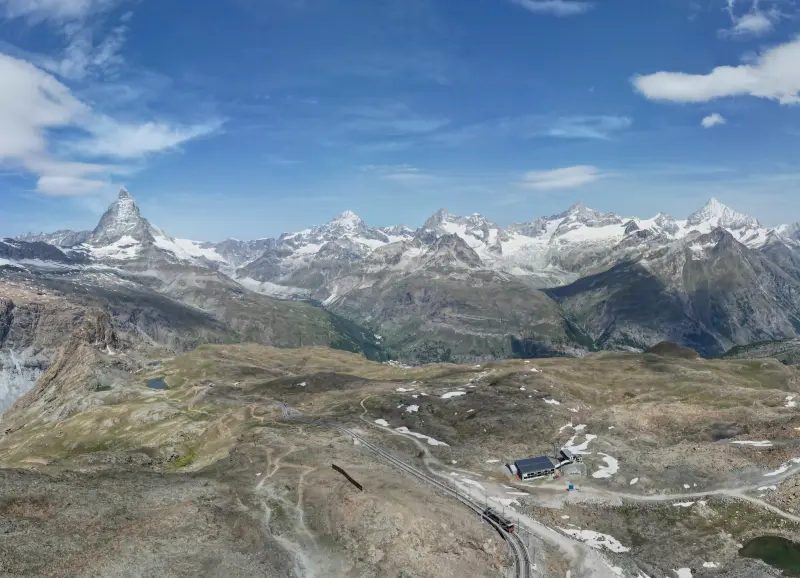
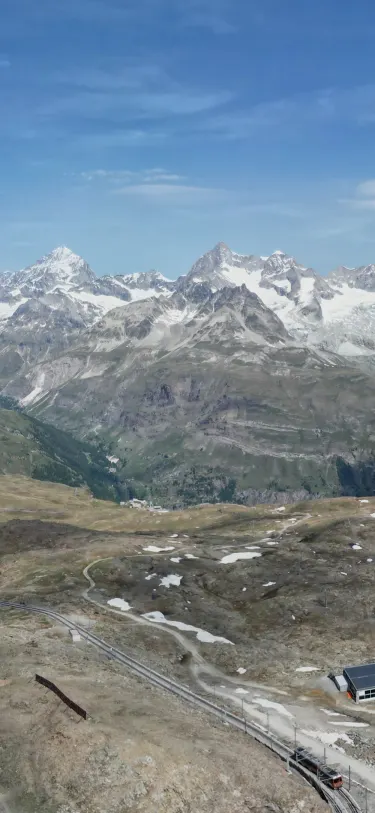 Dent Blanche4,358 m · 14.5 kmOber Gabelhorn4,073 m · 10.9 km9:41Dent Blanche4,358 m · 14.5 km away

Why the summits stay lit after you lose the sun
When the sun sets where you stand, it hasn't set everywhere. A summit a couple of thousand meters above you sees farther around the curve of the Earth, so it keeps the sun for a few more minutes. The World Meteorological Organization's International Cloud Atlas describes exactly this: near sunset the sun can be hidden for a low observer while the mountain tops may still be in the Sun's direct rays, and they take on a rosy, pink or yellow tint.
Its color comes from the path the light takes. Sunlight reaching a summit at that moment has skimmed through a long, low slice of atmosphere, and air scatters blue light far more than red. NASA's Space Place explains that with the sun low, even more of the blue is scattered, allowing the reds and yellows to pass straight through. What's left paints the snow.
According to the Cloud Atlas, the glow ends after a brief bluish phase, once Earth's shadow reaches the peaks. That shadow rises up the mountain from below, so you can watch the line of light climb the face and shrink to the very top.
The second glow, and the argument over the word
Losing the direct light doesn't always end the show. The Cloud Atlas notes that sometimes a second or third glow appears, as snowfields catch the "purple light", a faint purple glow that spreads across the sky in clear twilight. The American Meteorological Society's Glossary of Meteorology describes alpenglow the same way, as the occasional reappearance of sunset colors on a (snow-covered) mountaintop soon after sunset, unfolding in stages.
This is where the definitions split.
- The loose sense covers any rosy light on mountains at sunrise or sunset, direct sunlight included. That's how the Cloud Atlas opens its entry, and how most people use the word.
- The strict sense keeps the word for the indirect glow only, after the summits have lost direct sun. The Wikipedia article takes this line, and so does Digital Photography School's explainer, which calls the sky a giant reflector bouncing light onto the scene.
Photographer Dan Bailey argued in 2018 that most of what people photograph as alpenglow is direct light, seen from below after the sun has left the viewer. His test is simple: if the glowing face shows sharp shadows, it's direct sun. In a 2024 comment on the post he accepts that "true" alpenglow, in the strict sense, comes after the direct light has gone. Both camps agree on the physics. They only disagree on which stage gets the name.
How long alpenglow lasts
Direct light on a summit lasts about as long as it takes the sun to sink by the extra angle a summit can see past your horizon. That angle depends on how high the summit stands above you, and how fast the sun sinks depends on your latitude. Here's that window over a flat horizon around the equinoxes, using the standard refraction value (k = 0.13) the app uses for its sightlines:
| Summit above you | Equator | 40° N | 50° N | 60° N |
|---|---|---|---|---|
| 3,300 ft / 1,000 m | 4 min | 5 min | 6 min | 8 min |
| 6,600 ft / 2,000 m | 5 min | 7 min | 8 min | 11 min |
| 9,800 ft / 3,000 m | 7 min | 9 min | 10 min | 13 min |
These are geometry, not a forecast. In a valley your own sunset often comes early because a ridge blocks the sun, which stretches the time the summits stay lit while you're in shadow. Near the solstices the sun sets at a shallower angle at mid and high latitudes, which stretches the window too. The indirect glow can follow for several more minutes while the twilight sky stays bright.
Sunrise alpenglow seems to be the rarer kind: the AMS glossary says it appears to be much less common at sunrise than at sunset.
Alpenglow, the Belt of Venus and golden hour
Turn your back on the sunset and you'll often see a pink band low in the sky with a dark blue-gray band under it. The dark band is Earth's shadow, and the pink above it is the Belt of Venus. Sky & Telescope's Tony Flanders describes it as the light of the sunset where you're standing reflected off the atmosphere to the east, and notes that the pink has faded about 15 minutes after sunset. It's the same reddened light as alpenglow, landing on air instead of rock.
Golden hour is the stage before. The sun is low but still up where you are, so everything around you is warm and directly lit. Alpenglow starts when that light leaves you and survives only on the high ground.
Some ranges have their own name for it. In the Dolomites it's enrosadira, from the Ladin for "becoming pink"; Trentino's tourism board credits the dolomite rock itself, a calcium and magnesium carbonate, for the strong color, alongside the legend of King Laurin's rose garden turned to stone.
Where to look, and which peak is glowing
- Face away from the sun. At sunset, look east at the slopes facing the sunset. At sunrise, look west.
- Pick snow or pale rock. Dark forest barely shows the color. Snowfields, glaciers and pale rock faces show it most.
- Watch the horizon toward the sun. A bank of cloud there can block the low light before it reaches the summits, even if the sky above you is clear. Haze has its own effects, covered in our guide to why distant mountains look blue.
The last peak to glow is the one standing highest above the rising shadow, and that isn't always the one nearest you. A big summit far back in a range can stay lit while closer, lower ridges have gone dark, so the glowing peak can be farther away than you'd guess. How far you can see one depends on its height and the curve of the Earth; our guide to how far away you can see a mountain has the numbers.
To put a name on it, Mountain Identifier: Peaks labels the peaks in view with name, elevation and distance, and checks line of sight against the terrain so a peak hidden behind a nearer ridge stays hidden. It searches peaks within 80 km (about 50 miles).
If it's too dark for the camera view, the app can switch to a rendered 3D panorama of the terrain with the same peak labels. Identifying peaks this way, in the live view or that panorama, is part of the Pro subscription. For other ways to work out a mystery summit, see what mountain is this?
Frequently asked questions
What causes alpenglow?
Low sunlight crosses a long path of air, which scatters most of its blue away and leaves red and orange. Summits stand high enough to keep catching that light after the valleys are in Earth's shadow. Once the summits lose direct sun too, light scattered by the twilight sky can still tint them pink or purple.
When does alpenglow happen?
Just after sunset and just before sunrise, while the sun is a little below your horizon. The direct glow on a big peak lasts a few minutes, longer at high latitudes where the sun sets at a shallow angle. The American Meteorological Society's glossary says it seems much less common at sunrise than at sunset.
Is the Belt of Venus the same as alpenglow?
They're close relatives. The Belt of Venus is the pink band in the sky opposite the sunset, sitting just above the dark blue band of Earth's shadow. Alpenglow is reddened light landing on mountains; the Belt of Venus is reddened light lighting up the air itself. You often see both in the same view.
Can you see alpenglow every day?
Not every day. You need a clear path for the low sun to reach the summits, so cloud on the horizon toward the sun can cut it off. Haze, smoke or cloud around the peaks can mute it too. Snow or pale rock shows it best.
Is alpenglow the same as golden hour?
No. Golden hour is the stretch when the sun is low but still up where you are, and everything around you gets warm direct light. Alpenglow comes right after it at sunset (and just before it at sunrise): you're in shadow and only the high ground is lit.
Next time, point your phone at it.
Name, elevation and distance for the peaks in your camera view. Free to download; identification is part of Pro.
 Dent Blanche4,358 m · 14.5 kmOber Gabelhorn4,073 m · 10.9 km9:41
Last reviewed Nov 18, 2026. Peak data © OpenStreetMap contributors (ODbL).